Addition
Plenty of activities to help children develop quick mental methods of addition, which is the key to success in Year 3. Written methods of addition are used for the first time.
Mental addition in Year 3 gets quite a lot harder and it will be important to revise the skills and knowledge learned in Year 2 before moving on to new targets.
Three key targets are:
Add a 3-digit number and ones e.g. 400 + 5 =
Add a 3-digit number and tens e.g. 400 + 50 =
Add a 3-digit number and hundreds e.g. 400 + 500 =
Children will also be expected to solve word problems, often using just mental methods and jottings.
There are many tips and tricks which can help children rapidly calculate mentally which can be found on our extensive Addition category and don’t forget to visit our Addition on-screen activities which provide unlimited practice.
Formal written methods of addition are introduced, including adding two 2-digit numbers. However, the long term aim would be to only use written addition for larger numbers. There should be no need to use written methods to add two 2-digit numbers, it can all be done, ‘in your head’. That’s the theory and by Year 3 children will begin to put this into practice.
One of the key aspects of becoming proficient with this is recognising that most of us do a mental calculation in a different order than doing the same calculation in writing.
For example: 27 + 35.
Written methods would begin with the ones, 7 + 5. When working mentally I start with the tens and add 20 and 30, then add the 7 and finally add the 5. (Actually I think I add the 30 to the 27 in one go and then add on 5.)
Another way is to add the tens (20 + 30) and then add the ones (7 + 5) and add the two answers.
Of course, you might start by adding the ones, and there is nothing wrong with this, but it does not seem to be the usual way that people who are really fast with mental calculations work. Children need these techniques explained to them. The important thing to stress is that the quickest mental method is unlikely to be the same as the written method.
Another technique which is particularly important is adding the nearest whole ten and adjusting. An example of this can be seen when adding 47 and 38. An easy way to do this is add 47 and 40 making 87 and then adjusting by subtracting 2 to make 85. Done! This is probably an easier way than adding the 40 and 30 and then adding the ones.
When adding several small numbers it is always useful to look for pairs that make 10. This works because addition can be done in any order.
For example 7 + 8 + 3 = ? is done easily by adding 7 and 3 to make 10 and then adding the 8 to make 18. By the end of Year 3 children begin to know by heart all pairs of single digits which add up to 10.
We have a vast selection of pages to help with all mental addition.
Revise mental skills for addition
Resources to help with revising and consolidating simple mental addition skills.


Adding multiples of ten and a hundred
Plenty of practice adding multiples of 10 and 100 mentally.


Mental addition skills
Help with developing a range of addition skills to enable fast calculating.


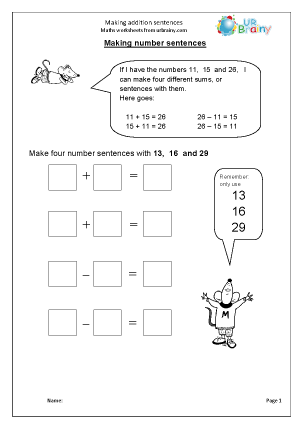



Bar modelling for addition
Using bar models to illustrate the process of addition.


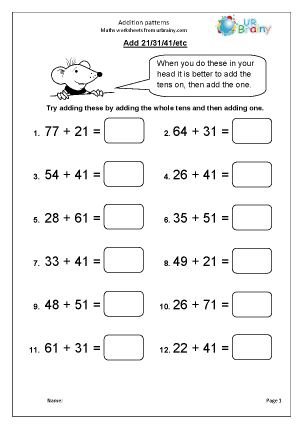
Master mental addition
Looking for patterns is a great way to help master addition in Year 3.


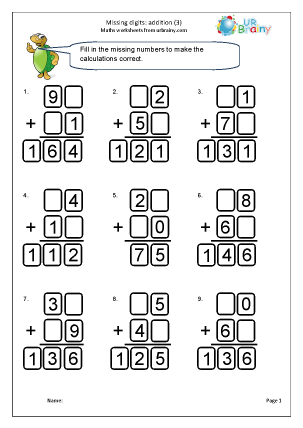
Written addition
Tutorials and worksheets introducing the formal written method for addition.


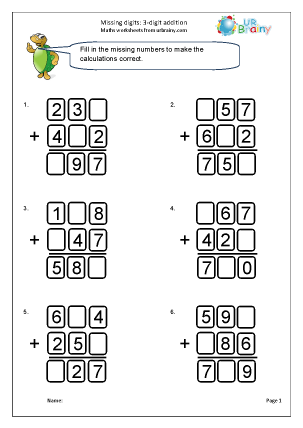
Further addition skills


Subscribe to our newsletter
The latest news, articles, and resources, sent to your inbox weekly.


© Copyright 2011 - 2026 Route One Network Ltd. - URBrainy.com 14.0.38