Just how quickly can times tables be recited? It is still important to practice times tables, especially the harder ones, such as the sevens and eights. This knowledge can then be employed to work out related multiplications, such as multiplying by 21 or 19. A good mental knowledge will also help with refining written methods of multiplication, including the use of simple decimals.
Another look at multiplying by zero and one, and the relationship between multiplication and division.
Doubling 2-digit numbers and halving 3-digit numbers mentally.
Some people like to start doubling with the units, others like to start with the tens. It doesn’t matter as long as the method is fast and accurate.
More work on doubling and halving, including larger numbers and fractions.
When we are multiplying by a number ending in 5 we can double the number and halve the other number before multiplying (by a multiple of ten, making it easy).
Some people (especially those who still use feet and inches!!) think it is important to know how to multiply by 12. It’s easy – just add 10 times the number to 2 times the number.
To multiply by 21, just multiply by 20 and then add the number on. (To multiply by 20, double and times by 10.)
When multiplying 2-digit numbers by 1-digit in your head usually it is easier to start with the tens.
Multiplying three digit multiples of 100 is fairly easy, but there are some addition adjustments to make on some of these.
All the questions on these pagers can be done mentally: the important part is explaining the method that was used.
When working out which of these number sentences are true remember that the part in brackets should be worked out first.
Moving towards a written method of multiplication. If we have a two digit number multiplied by a two digit number, we can split each number into tens and units and multiply both parts of the first number by both parts of the second number.
Setting multiplication calculations out in a vertical format, ready for the standard method.
Practice with multiplying two digit numbers by one digit, using the standard written method.
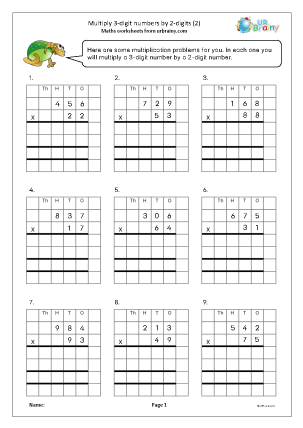
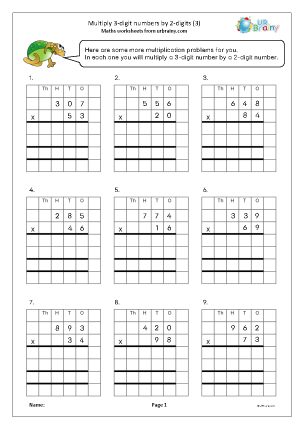
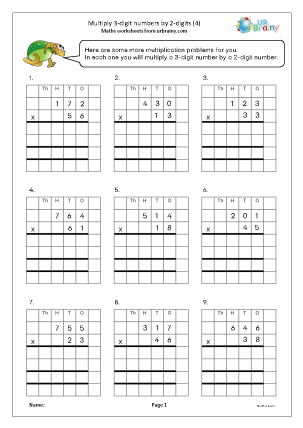
Use the standard short method of multiplication with 3-digit numbers, but just keeping to the 2x, 5x and 10x tables.
More practice using the standard written method of multiplication, this time with decimals.
An introduction to square numbers and the number patterns associated with them.
You can get a multiple of a whole number by multiplying it by another whole number. A factor of a number will divide into the number exactly, without a remainder.
A whole number which only has factors of 1 and itself is known as a prime number.
A variety of methods for checking answers, not just multiplication.
Use a variety of strategies to work out the missing numbers. A good knowledge of times tables is needed.
A quick look at the concepts of multiplication children are expected to understand in Year 5.
A brief look at written multiplication in year 5.