Children should be able to divide numbers up to 1000 by 10 or 100 (whole number answers) and understand the effect of this. Written methods of division of 2-digits by 1-digit are developed, including writing remainders as fractions. Calculators are also used to help with understanding division.
Division can be used to find fractions and percentages of numbers and quantities. Children will also be moving on towards a standard written method of division, using it at first with smaller numbers.
Revising division, including what happens when you divide by one and if it is possible to divide by zero.
Remember to move the digits two places to the right to divide by 100.
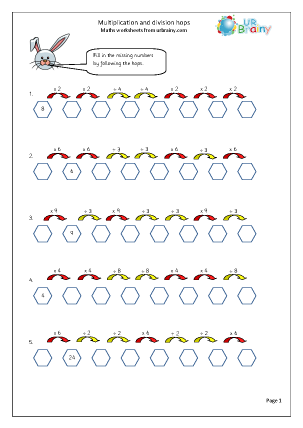
Fill the missing numbers by hopping forwards and backwards. Multiplication and division practice.
We return to an important concept again: the relationship between multiplication and division.
A mixed bag of quick fire questions on division.
Understanding and using factors of numbers can make mental multiplication easier.
Moving towards a standard long division method.
Practise the written method of division with some easier 2-digit numbers.
What happens when a number is multiplied or divided by 10, 100 or 1000?
Knowing multiplication tables really helps with fractions.
Practice using the standard method of division, keeping to dividing two digits by one digit.
Introducing decimals using the standard method of division.
A step by step approach for short division, using 3-digit numbers and dividing by 5.
Use the short division method to divide 3-digit numbers by 6.
More division practice using the short method when dividing by 7.
A step by step approach to dividing by 8, using the short method.
Using the standard short division method and just the 9 times table to work out the answers to these division questions.
Finding fractions of numbers: most of these need to be done in two steps.
Finding percentages of numbers.
Tips and hints on using a calculator, including negative numbers and recurring decimals.