Number and Place Value
High quality tutorials and printable resources to help with ordering numbers, place value and partitioning.
There are some tough challenges in the Year 2 Programme of Study. Let’s begin by looking at ‘Number and place value’, which states:
Pupils should be taught to:
• count in steps of 2, 3, and 5 from 0, and in tens from any number, forward or backward
• read and write numbers to at least 100 in numerals and in words
• compare and order numbers from 0 up to 100; use <, > and = signs
• recognise the place value of each digit in a two-digit number (tens, ones)
• identify, represent and estimate numbers using different representations, including the number line
• use place value and number facts to solve problems.
Writing numbers to at least 100 in words is a real challenge which quite a few children will not be able to manage by the end of the year. The teen numbers are challenging, such as thirteen and fourteen, whilst when spelling whole tens, forty mysteriously loses the ‘u’.
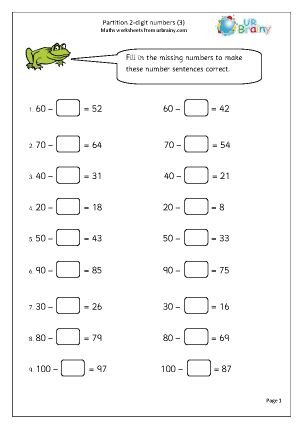
A key idea in this category is partitioning numbers in different ways. For example:
24 can be split up or partitioned into 20 + 4 or 10 + 14 or even 12 and 12.
This is important to understand as it helps with written addition and subtraction in later years. Also it is important to begin to understand zero as a place holder; i.e. the 1 in 100 has a value ten times the 1 in 10, with the zeros being used as place holders.
Counting in multiples of 3 is a new target, introduced to help later with understanding the concept of a third.
The ‘more than’ and ‘less than’ signs are introduced for the first time; terms which in the past were introduced much later.
We have a great selection of worksheets on all these topics, so why not take a closer look?here are some tough challenges in the Year 2 Programme of Study. Let’s begin by looking at ‘Number and place value’, which states:
Pupils should be taught to:
• count in steps of 2, 3, and 5 from 0, and in tens from any number, forward or backward
• read and write numbers to at least 100 in numerals and in words
• compare and order numbers from 0 up to 100; use <, > and = signs
• recognise the place value of each digit in a two-digit number (tens, ones)
• identify, represent and estimate numbers using different representations, including the number line
• use place value and number facts to solve problems.
Writing numbers to at least 100 in words is a real challenge which quite a few children will not be able to manage by the end of the year. The teen numbers are challenging, such as thirteen and fourteen, whilst when spelling whole tens, forty mysteriously loses the ‘u’.
A key idea in this category is partitioning numbers in different ways. For example:
24 can be split up or partitioned into 20 + 4 or 10 + 14 or even 12 and 12.
This is important to understand as it helps with written addition and subtraction in later years. Also it is important to begin to understand zero as a place holder; i.e. the 1 in 100 has a value ten times the 1 in 10, with the zeros being used as place holders.
Counting in multiples of 3 is a new target, introduced to help later with understanding the concept of a third.
The ‘more than’ and ‘less than’ signs are used; terms which in the past were introduced much later.
We have a great selection of worksheets on all these topics, so why not take a closer look?
Counting on and back
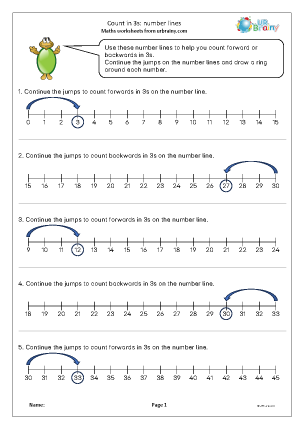
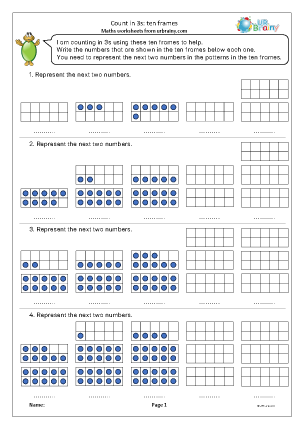
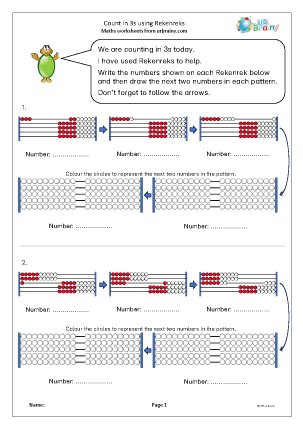
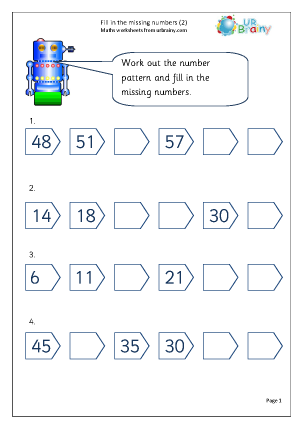
Counting forms a major part of Year 2 maths, including counting on in threes, fives and tens up to at least 100. Number lines and number squares are often used to help with counting and positioning numbers.






Reading and writing numbers
Resources to cover reading and writing numbers to at least 100 in numerals and in words.


Ordering numbers
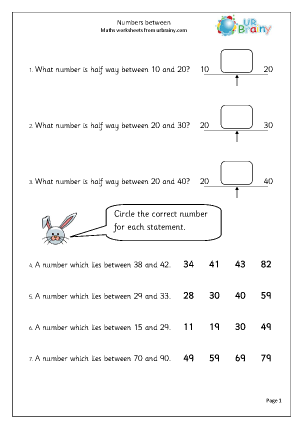
Here we compare and order numbers from 0 up to 100, as well as using the <, > and = signs. Children will be expected to order numbers up to 100 and use the more than and less than signs.





Odd and even numbers


Place value and partitioning (100s 10s and 1s)
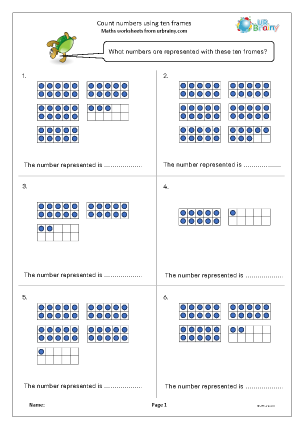
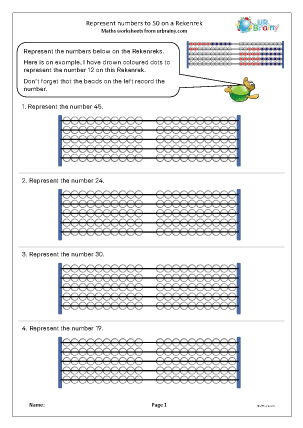
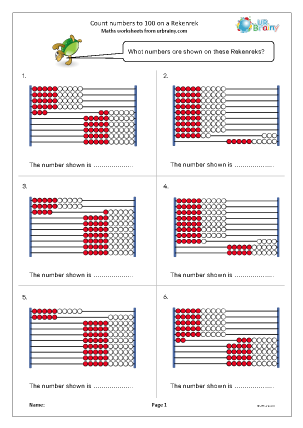
These resources cover two very important targets: recognising the place value of each digit in a two-digit number and using place value and number facts to solve problems. Understanding place value is the key to working with larger numbers. Bar models, abacuses and place value grids all help with this.







Number lines
Number lines are a great resource to help with counting and estimating.


Estimating
Being able to estimate a small amount is an important skill for Year 2 children.


Subscribe to our newsletter
The latest news, articles, and resources, sent to your inbox weekly.


© Copyright 2011 - 2026 Route One Network Ltd. - URBrainy.com 14.0.35