With tables known ‘off by heart’, mental multiplication includes multiplying tens and units by units (25 x 6 etc) and units and tenths by units (3.4 x 5 etc). Square numbers will also be known. The standard written method of multiplication will be used efficiently when necessary.
A summary of the main concepts involving multiplication, including multiplying by one and by zero and the relationship between multiplication and division.
Quick question sheets to check how well multiplication facts are known and concepts are understood.
A quick revision to check that tables are known and square numbers understood.
Tips and hints on how to use mental methods to double and halve larger numbers, including 3-digit numbers.
Using tables knowledge and doubling to multiply by 12, 24, 18 etc.
Use knowledge of factors to help with multiplying and dividing larger numbers: quite difficult concepts.
How about trying to multiply by 14 or 16 in your head?
Multiplying by 101 or 99 in your head. Sounds difficult, but you can do it by multiplying by 100 and then adjusting.
Multiplying whole numbers and tenths by a single digit. When multiplying numbers like these it is a good idea to start with the whole number or units.
Multiply a decimal fraction by 10 or 100: remember to move the digits one place to the left.
Continue to work with square numbers up to 20 squared. Try to learn all these.
Reminder: the factors of a number are those numbers that divide exactly into it, without leaving a remainder. A number which only has factors of 1 and itself is called a prime number.
More on square and cube numbers. You may have noticed that cube numbers start getting pretty big, pretty quickly.
The prime factors of a number are the factors which are also prime numbers. They can be found by using a factor tree.
A mixed selection of questions involving multiples and making a rule from number patterns.
We are now moving towards efficient, or standard written methods of multiplication.
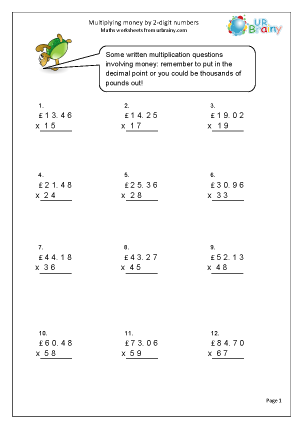
Using the standard written method to multiply 2-digit numbers.
The short multiplication method described, with practice pages multiplying 3-digit numbers by a single digit.
Using the standard written method to multiply decimals.
It is very important that when faced with a series of sums in a line that they are calculated in the correct order. Believe it or not this may not be the order that they come!
The standard, or efficient method of multiplying two 2-digit numbers.
More long multiplication practice, using the standard method.
Practice the standard method of multiplying 3-digit numbers by 2-digit numbers.