Number and Place Value
High quality printable resources to help with Number and Place Value in Year 3.
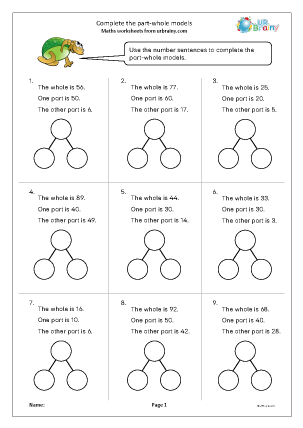
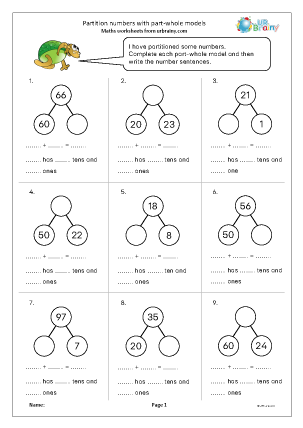
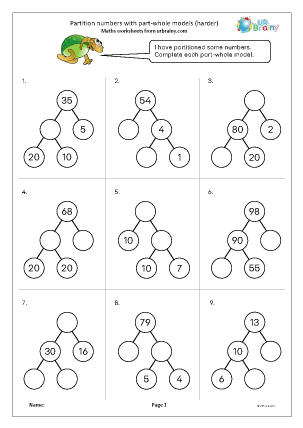
Building on the work done in Year 2 children will understand that 100 is made of ten tens and count in multiples of 100 up to 1,000. They should also understand that a 3-digit number is made up of 100s, 10s and 1s and successfully read and write 3-digit numbers. Place value grids and part-whole models are great ways to help with this.
Number lines are still really useful, especially when putting numbers in order and estimating.
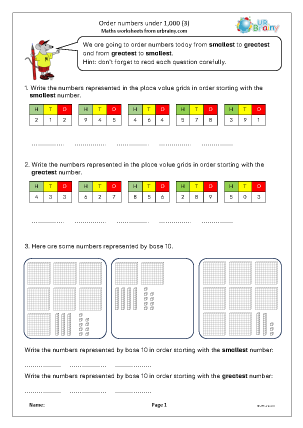
Children will move on to finding 10 or 100 more or less than a number and they will also compare 3-digit numbers and order them from smallest to largest.
Being able to confidently count in fives will help with counting on and back in fifties.
Using number cards is a great way to help children understand place value and we would like to feature a set of worksheets for Year 3 which require children to write down all the possible 3-digit numbers that can be made using three different number cards.
For example: what 3-digit numbers can be made from 5, 6 and 7? By moving the cards round children should be able to make 6 different numbers:
765 756 675 657 576 567
They are then asked to write down the smallest and largest of these numbers. This can be repeated almost endlessly with a set of digit cards from 0 to 9, selecting any three of the cards. Ordinary playing cards are excellent for this but if they are not handy we have number cards available on the site in Further Resources: Number Lines etc.
Counting on and back
Resources to help with counting on and back, including counting in tens, fifties and hundreds.


Place value
Understanding place value is a crucial part of children’s learning and our resources include base 10 blocks, place value charts and part-whole models to help with this.




Comparing and ordering numbers
Plenty of great pages on comparing 3-digit numbers, putting numbers in order and using the more than and less than signs.




Estimating and rounding
Rounding numbers to the nearest 10 and 100, estimating on a number line and finding approximate answers are all covered in this category.


Further number work
Extension work on number, including multiples and Roman numerals.


Subscribe to our newsletter
The latest news, articles, and resources, sent to your inbox weekly.


© Copyright 2011 - 2026 Route One Network Ltd. - URBrainy.com 14.0.37