Subtraction Year 2 (aged 6-7)
An extensive range of resources to help with the recall of subtraction facts to 20, subtracting a 1-digit number from a 2-digit number and problem solving.
Subtraction really takes off in Year 2 as the knowledge and skills gained in Year 1 are extended to larger numbers.
Pupils should be taught to:
• recall and use subtraction facts to 20 fluently
• derive and use related facts up to 100
• subtract numbers using concrete objects, pictorial representations and mentally
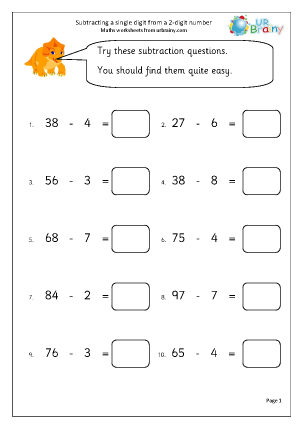
• subtract a single digit from a 2-digit number
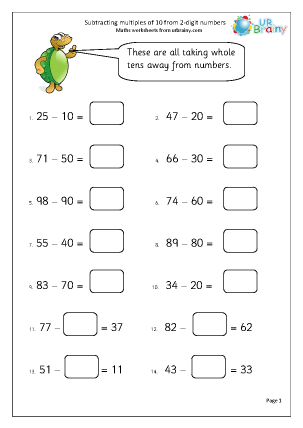
• subtract whole tens from a 2-digit number
• subtract two 2-digit numbers
• recognise and use the inverse relationship between addition and subtraction and use this to check calculations and missing number problems.
• solve problems with subtraction using concrete objects and pictorial representations, including those involving numbers, quantities and measures
• apply their increasing knowledge of mental and written methods
It is also suggested that children should begin to use columns to record their subtraction calculations, in readiness for the formal written method next year.
There is a great deal of work that needs to be done to meet these targets including understanding and reading various terms related to subtraction, such as:
take away, subtract, how much less is, difference between as well as reading and writing the minus (-) sign.
As with addition the emphasis is put on mental arithmetic so that by the end of the year children are responding quickly and accurately to oral and written questions. The key this year is to really learn basic number facts off by heart and then use them to work out other facts.
Three important areas are:
a. using known facts to work out other facts e.g. knowing 9 - 5 = 4 can be used to work out
quickly 90 - 50. This relates to knowledge of place value in number work.
b. understanding that subtracting zero leaves a number unchanged
c. understanding that 4 – 2 for example, is different from 2 - 4
d. using inverse operations to check answers e.g. to check 10 – 7 = 3 by adding 7 and 3 to make 10.
With well over 100 colourful pages of subtraction worksheets there is plenty to choose from and don’t forget to have a go at our Year 2 Subtraction Games.
Developing mental arithmetic skills


Fast mental subtraction skills
Here you will find plenty of practice at subtracting mentally, including subtracting single digits from 2-digit numbers, subtracting multiples of 10 and completing number sentences.







Real life problems using subtraction


Subtraction in columns
Once children are really confident with mental subtraction they can be introduced to simple written subtraction using columns.


More subtraction activities
Further subtraction activities including recognising the relationship between addition and subtraction, which can be used to check answers.


Subscribe to our newsletter
The latest news, articles, and resources, sent to your inbox weekly.


© Copyright 2011 - 2026 Route One Network Ltd. - URBrainy.com 14.0.36