A child who achieves what is expected by the end of Year 6 will have an excellent knowledge of number. Negative numbers will be used in a variety of situations, including co-ordinates. Decimal fractions are extended to thousands and children will be expected to round decimals with up to three decimal places. Terms such as simplifying fractions, cancelling common factors, percentages and ratio will all be used with confidence.
Rounding very large numbers to the nearest ten thousand and rounding populations to the nearest million.
Estimating on a 0 to 10000 number line and making approximate answers to calculations.
Mini investigations involving amounts of time, large numbers and, not forgetting, blades of grass!
Co-ordinates with negative numbers, including temperature and tide levels.
Co-ordinates in four quadrants are an excellent way to demonstrate knowledge of negative numbers.
Estimating and then measuring to the nearest millimetre requires a great deal of accuracy.
Changing mixed numbers to improper fractions and vice versa. Cancelling fractions.
Lecnac is the opposite to cancel – there’s no other word for it!
More on equivalent fractions and simplifying fractions.
Finding a fraction between two other fractions shows a really good understanding of equivalence.
Ordering fractions with the help of a blank number line. Again, equivalent fractions need to be understood to successfully complete these pages.
Working with numbers to three decimal places; recognising tenths, hundredths and thousandths.
Using only the multiplication or division calculator keys change one decimal fraction to another.
Ordering decimal fractions. Sounds easy, but can be quite tricky.
Rounding decimals to the nearest whole one, including rounding to kilograms and kilometres.
Rounding decimals to the nearest tenth, including rounding metres and kilometres.
When rounding to the nearest tenth you need to look at the hundredth digit. Also, word problems which need sensible decisions whether you should round answers up or down to the nearest whole one, or round to two decimal places.
Using a calculator, changing fractions to decimals, including looking at patterns such as ninths and sevenths.
More on converting fractions and mixed numbers to decimals.
Using a calculator to decide the size of fractions and some more converting fractions to decimal fractions.
Writing percentages as fractions and as decimals, as well as interpreting pie charts.
Finding percentages of numbers and money. Word problems using percentages.
Word problems and shape patterns involving ratio and proportion.
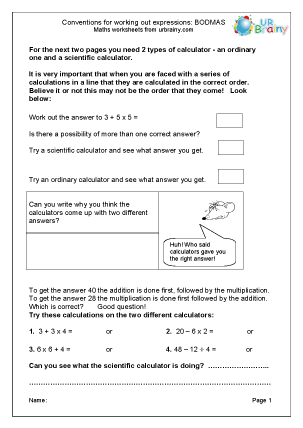
Remember, in a number sentence where there are several operations we need to stick to some rules.
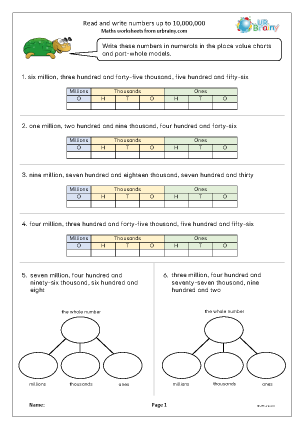
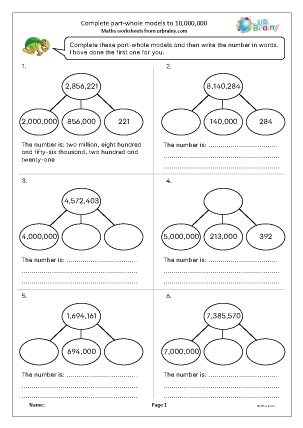
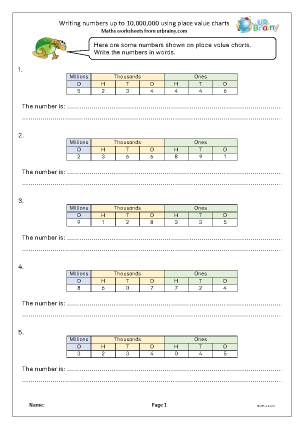
Reading and writing very large numbers: harder than it seems!