Measuring in Year 6 (age 10-11)
A challenging collection of worksheets ensuring that standard metric units will be used confidently, including area and volume.
There are some very hard concepts involved with Measurement in Year 6. Conversion of units of measurement continues to be a key element, and it is suggested that converting between units such as kilometres and miles is done graphically. Converting metric units should be done with up to 3 decimal places.
Calculating the area of shapes, including parallelograms is an important target, with some areas e.g. rectangles, being found by using formulae. By Year 6 children should have a secure understanding of the difference between perimeter and area. Many children can be confused as to the difference and will often work out area by measuring round a shape; misunderstanding the rule for calculating the area of a rectangle.
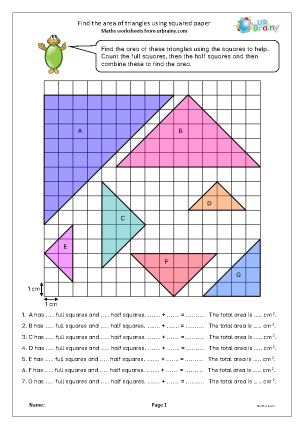
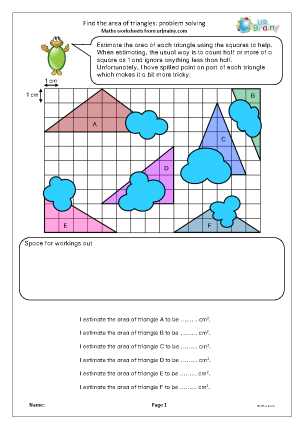
Finding the area of more complex shapes, or shapes which can be split into several rectangles, is also introduced, together with the surface area of boxes. With 3D shapes it is very helpful to have real objects handy to discuss the number of sides etc. The area of right angled triangles is calculated by halving rectangles.
An enjoyable extension activity involving measuring and calculating perimeter and area is to work with circles. There are many examples of circles in the real world that can be used for practical work eg measure round the outside of a baked bean tin etc.
With a little help and a lot of practical work, children should be able to see that there is a relationship between the circumference of a circle and the diameter - the circumference being about 3 times the diameter.
From this pi can be introduced, usually as 3.14 and the sign can also be introduced - π
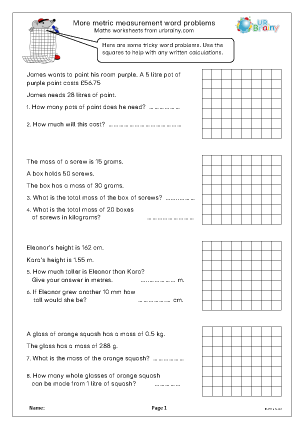
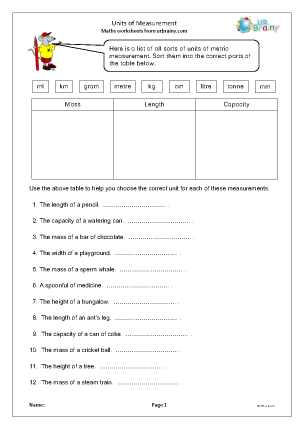
Metric measurements



Imperial and metric measurements


Area and perimeter




Volume


Subscribe to our newsletter
The latest news, articles, and resources, sent to your inbox weekly.

© Copyright 2011 - 2026 Route One Network Ltd. - URBrainy.com 14.0.33