If tables are known ‘off by heart’ then division becomes much easier! Beginning with finding halves and then division by grouping, children will soon understand that division is the inverse of multiplication. By the end of the year they will even be carrying out simple division calculations with remainders in the answer.
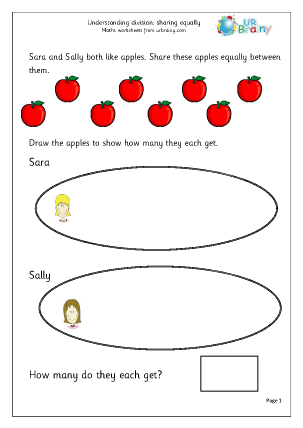
First steps with division, using knowledge of the two times table to answer division questions.
Moving on from sharing between two to sharing between three and four.
It's a good idea to have learnt the 5x table before trying these division questions.
Dividing by ten is probably the easiest of all division questions; apart from dividing by 1!
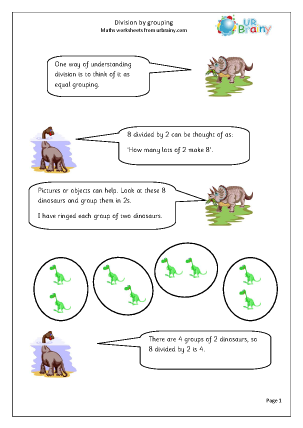
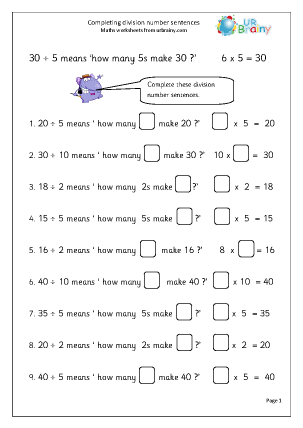
One way of understanding division is to think of it as equal grouping.
Some tricky word problems which need a good knowledge of halves of small numbers!
Another set of dividing by 10 questions, in the shape of a star.
Good practice at division and could be used as a speed challenge to test knowledge of tables.
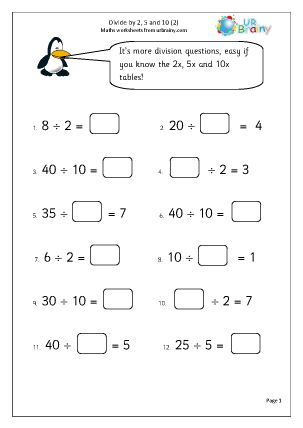
It's more division questions. Easy if you know the 2x, 5x and 10x tables.
A different way at looking at tables - division tables rather than multiplication!
Know division tables for 2, 5 and 10 with answers up to 12.
The 3x table is harder to learn, but is really useful when answering these divide by 3 questions.
Sharing, or division problems using a range of maths vocabulary.
More practice at dividing multiples of 3, with no remainders.
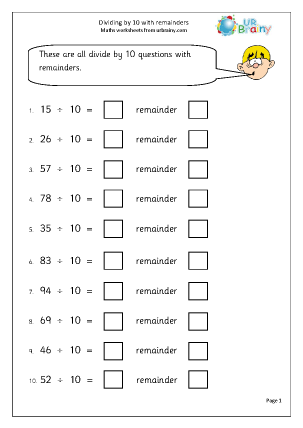
These are all divide by 10 questions with remainders.
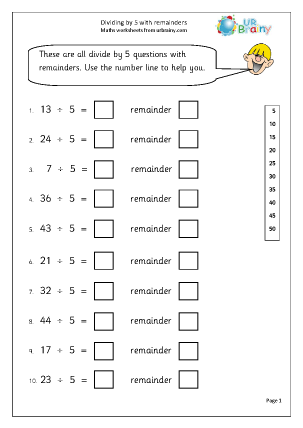
There is a number line to help with these dividing by 5 questions which have remainders.
Introducing remainders when mentally dividing by 3.
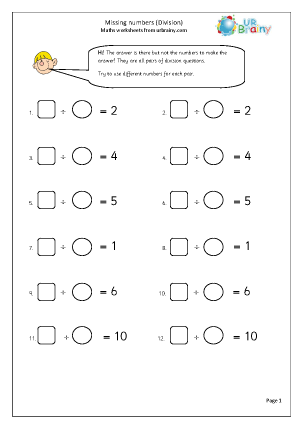
Use different numbers to make the pairs of division sentences correct.
Very tricky set of questions showing whether children understand division.