As children become more accurate with their drawing great fun can be had with 2D and 3D shape work. Polygons are drawn and classified and nets of 3D shapes are introduced. Lines of symmetry, as well as reflections and translations are introduced. Children will be expected to know that angles are measured in degrees and they will begin to compare and order angles.
Identifying 3D shapes including hexagonal prisms and tetrahedrons: quite difficult words for many children.
Identifying 2D shapes including isosceles triangles and heptagons. Also introducing concave and convex shapes and more sorting shapes using Venn and Carroll diagrams.
Edges, faces, vertices of prisms, nets of cuboids and making 3D shapes are just some of the activities in this set of worksheets.
Lines of symmetry: look out for shapes with more than one line of symmetry.
Drawing reflections is much trickier than you might think. Some children (and adults) have real difficulties with these.
Translation in maths just means slide the shape along a certain distance. Try drawing the picture by translating the shapes as shown.
When plotting points on a grid remember the first number is the number of squares along and the second number is the number of squares up. Some great drawings to plot, but care needs to be taken!
Co-ordinates, columns, rows and diagonals are all here. Remember to use the brackets and a comma when writing down a pair of co-ordinates.
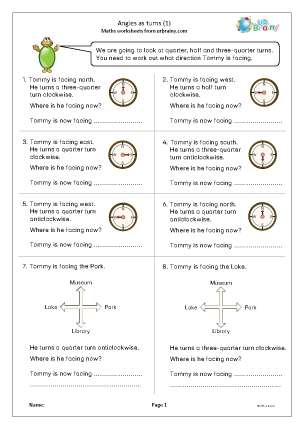
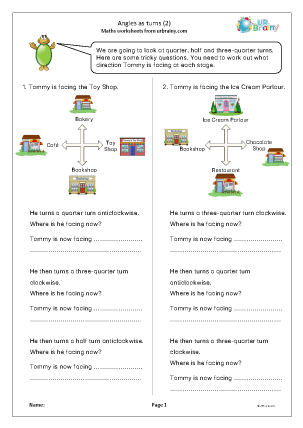
Angle is a measure of turn: a right angle is a quarter turn. Plenty of turning in this set of angle worksheets!
In one hour the hour hand of a clock turns 30 degrees. Knowing this means that the questions on these pages are quite straightforward.
A set square is a very useful tool for drawing 30, 45, 60 and 90 degree angles.
A brief description about 2D and 3D shape in Year 4.
A run through what is expected by the end of year 4.