Geometry (Shape)
Expectations are high when it comes to shape in Year 2! Children are expected to describe, visualise, classify and draw a wide variety of 2-D and 3-D shapes. Reflective symmetry is introduced and the idea that an angle is a measure of turn is very important to understand, as well as introducing the right angle.
In Year 2 children are expected to know some tricky vocabulary to do with 3-D shape, including recognising and naming cubes, cuboids, spheres, cones and cylinders.
At this stage, work with shape should be mainly practical using real shapes, but we include in the worksheets some simple pages of reinforcement and ideas for games and activities.
Schools will normally be stocked with plastic or similar shapes, both 2-D and 3-D, but parents can quickly and easily make a collection of the most common shapes from empty tins and packets (including those boxes from a popular triangular chocolate bar).
An important aspect of this is identifying 2-D shapes on the surface of 3-D shapes and we have also published a set of pages concentrating on this.
2D and 3D shapes
Identify, compare and sort 2D and 3D shapes according to their properties.


Right angles
Recognising right angles.


Symmetry
Finding lines of symmetry in shapes.

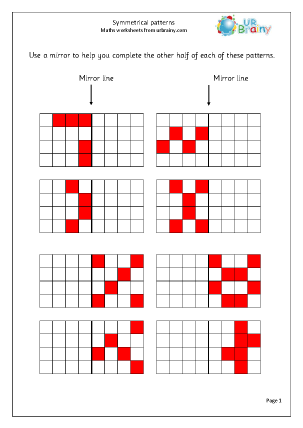

Patterns
Use knowledge of shapes to make and describe patterns.


Movement and turning
Describe position, movement and turning, including clockwise and anticlockwise.


